
Decoding the GHG Emission Protocol
Measure, Monitor and Control the Climate Impact
ESGLOBE
11/25/20252 min read
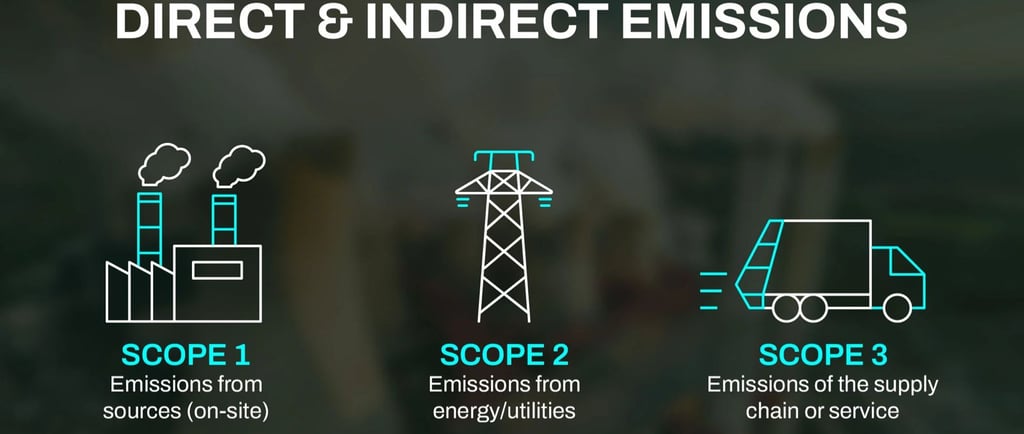
Scope 1, 2, and 3 emissions are categories used to classify a company's greenhouse gas (GHG) emissions, based on where the emissions originate. This classification system was established by the Greenhouse Gas (GHG) Protocol to help organizations measure and manage their climate impact.
Here's a breakdown of each scope:
Scope 1 Emissions: Direct Emissions
Scope 1 emissions are direct GHG emissions from sources that are owned or controlled by the company. These are emissions that physically occur at the company's facilities or from its assets.
Examples:
* Burning fuel (like natural gas, oil, or coal) in company-owned boilers, furnaces, or generators for heat or power.
* Emissions from company-owned vehicles (fleet cars, trucks, planes, etc.).
* Fugitive emissions, such as leaks from refrigeration and air conditioning units (HFCs) or methane leaks from natural gas pipelines.
* Emissions from manufacturing processes on-site.
Scope 2 Emissions: Energy Indirect Emissions
Scope 2 emissions are indirect GHG emissions from the generation of purchased electricity, steam, heat, or cooling consumed by the company. The emissions occur at the power plant or utility that produces the energy, not at the company's site, but they are a direct result of the company's energy consumption.
Examples:
* Emissions from the power plant that generates the electricity a corporate office or factory purchases from the grid.
* Emissions associated with the production of purchased steam or chilled water.
Scope 3 Emissions: Other Indirect Emissions
Scope 3 emissions are all other indirect emissions that occur in a company's value chain. These emissions are a consequence of the company's activities but occur from sources not owned or controlled by the company (and are not included in Scope 2).
Scope 3 is often the largest category, representing the majority of a company's total carbon footprint. It is broken down into 15 categories, covering both upstream (supplier-related) and downstream (customer-related) activities.
🔼 Upstream Activities (Inbound)
Emissions related to purchased goods and services, before they become part of the company's operations.
Examples:
* Purchased goods and services (e.g., the emissions from the raw material extraction, production, and transportation of components).
* Business travel (e.g., employee flights, train travel).
* Employee commuting to and from work.
* Waste generated in operations.
🔽 Downstream Activities (Outbound)
Emissions related to the use and end-of-life treatment of the company's sold products.
Examples:
* Use of sold products (e.g., the fuel burned by a car a manufacturer sold).
* End-of-life treatment of sold products (e.g., disposal of packaging or a product after its useful life).
* Transportation and distribution of sold products (when performed by a third party).